Some deliveries may take a little longer than usual due to regional shipping conditions.

DOWNLOAD THE APP


Customer Services
Copyright © 2025 Desertcart Holdings Limited
DOWNLOAD THE APP

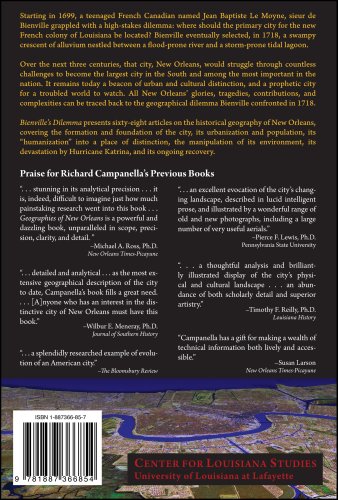
Bienville's Dilemma: A Historical Geography of New Orleans
J**S
Not just a geographic history, but a social history
I am doing research for a novel about 1820s New Orleans. I expected it to help me locate my story geographically, but it is doing so much more. Architecturally, socially - in many ways. Described it as the filthiest, most unhealthy city, and has accounts by many different visitors to NOLA. Recommend this book highly.
K**R
very enjoyable reading
I really enjoyed this book, combining 3 of my favorite things- history, geography, and New Orleans. I found the research on the gradual shifting of the population to lower and lower elevations over the most recent century and a half to be very shocking. Population shifts away from the natural levee combined with subsidence of the back-swamp (now covered with houses) puts the city on a collision course with mother nature, who in my estimate will always win eventually. The absence of over-washing by river flooding now is quite obvious, but it hadn't occurred to me that even if flooding did occur in the future, there is so much less sediment in the Mississippi due to extensive dam construction in the upper river ways that it wouldn't replete the land anyway.The ending sections about Katrina were less compelling as I feel the federal flood has been rehashed to death by now, but i appreciate that the events were fresher when the book was written. The highly detailed timeline at the beginning of the book was much appreciated. The extensive recounting as to why New Orleans is located where it is was fascinating. I bumped into that history a couple weeks ago leaving Jazz Fest, driving along the edge of an extremely suburbanized Bayou St John and coming upon an historical marked titled "The Old Portage". Ah! History lives! I spent some minutes trying to imagine what the portage must have looked like 300 years ago, and failed badly.I found the social observations accurate as well as amusing. As a part-time Nola resident, I find myself sometimes being more native than the natives. Yet I truly find the city amazingly compelling in a way I have never found any other place I have lived. I had an LOL moment as Campanella described the gentrification evolution from grungy street rat to hipster to liberal bohemian to gentry as a neighborhood population becomes more prosperous and shifts. I would submit that one can go through these shifts personally over the course of a life too, and having transitioned through 3 of the 4, I find myself in the position to (irritatingly) lavish money on restoring a property that will be a second home. Would it be better unrestored if lived in full time? Would it help to leave a house derelict? I fret over this too. (I DID find myself checking the elevation on my street and happily noted being above sea level.)Professor Campanella's love for his adopted city is clear. Which is why his clear view of its risk of annihilation again by flood is so frightening. In his long timeline, what impressed me a great deal was the sheer number of times New Orleans has already been nearly destroyed and yet has come back; almost uncountable times by hurricanes but also by fires. Having personally lived in south Florida for many years, we remind ourselves as another hurricane season approaches that it's not a case of "if" but "when."
K**R
NOLA's Dilemmas
An important book on New Orleans that gives us a fresh way to view the history and culture of this singular city. Mr. Campanella presents us with a series of dilemmas that the city and the people who populate it have grappled with from its founding to the present day. From the impact of landscape, environment and politics at its inception and its post-Katrina future, to the ebb and flow of the many cultures who have contributed to its unique character and place in America and the world.As with his previous book [[ASIN:1887366687 Geographies of New Orleans: Urban Fabrics Before the Storm] the author's depth and breadth of scholarship is impressive. Exhaustively researched and lavishly illustrated with photographs and illuminating graphics that bring alive the issues raised in the text. To call this book thorough and detailed would almost be damning it with faint praise.I finished it with a much clearer and richer understanding of the city and how its historical dilemmas have yielded to new but related ones. Resolving these, as it has been since Bienville's time, remains very much a work in progress. The how, where and why of New Orleans. Fascinating!
S**Y
Bienville's Dilemma - Understanding New Orleans
This is an extremely thorough but very readable account of how New Orleans became the way it is, geologically, geographically, historically and socially. Campanella has a clear and understandable style, and he avoids the trap of becoming too technically immersed in the subject to keep it interesting. It is filled with firsthand accounts and quotes, and provides a wealth of scientific and cultural background to give a clear picture of what happened over time and why. The book is divided into a detailed timeline, a series of 68 concise articles on almost every aspect of the city's development and challenges, an excellent series of color photos, illustrations and charts, and extensive notes. This is a real treasure to those who want to gain a more complete and accurate understanding of how this unique city developed and suffered the way it has, and what courses its future may take.
K**N
Must for NOLA lovers
Campenella is the foremost authority on the history and geography of New Orleans. While I've read some great histories of the city, no one gets to his level of detail regarding geography, demographics, architecture, and history; and all of this in a easy-to-understand manner. For anyone who can't get enough knowledge about NOLA, you have to check out this book. You'll gain an understanding of the city that will alter your outlook on the city when you're out and about in NOLA. You'll also gain an appreciation of just how unique NOLA is; there is no other city quite like it from a historical, geographical, and demographic point of view.I'm also currently reading his more recent book, Bourbon Street, and so far it great.
S**T
Horrible formatting detracts
from what is otherwise an interesting read. The first section (timeline) is horribly formatted. This should be formatted with the dates on the left and text on the right, and sometimes it is OK at first, but soon degenerates into an indistinguishable mess. Plus there are random missing letters in words throughout. An added minus - no maps or illustrations mentioned in the text can be found.As to content, it is a bit disjointed as any series of independent articles would be and there are some duplications as some replicate historical setting matter present elsewhere. But I do find them interesting and informative and , mostly, well-written.
S**L
Geological Background
Excellent review work for all those who ask "Why build a city here?" Strong in research and new (to too many) material about the past and future of New Orleans. I recommend the book to anyone interested in the "Why" of this great city.
Trustpilot
2 weeks ago
2 weeks ago